Moke News & Information
Moke Lithium Battery Guide: 60V vs 72V vs 76.8V vs 96V
Upgrading an electric Moke to lithium can improve range, performance, charging, reliability, and overall driving experience—but not all Moke lithium battery systems are the same. Voltage, capacity, physical size, installation requirements, motor compatibility, and controller capability all matter.
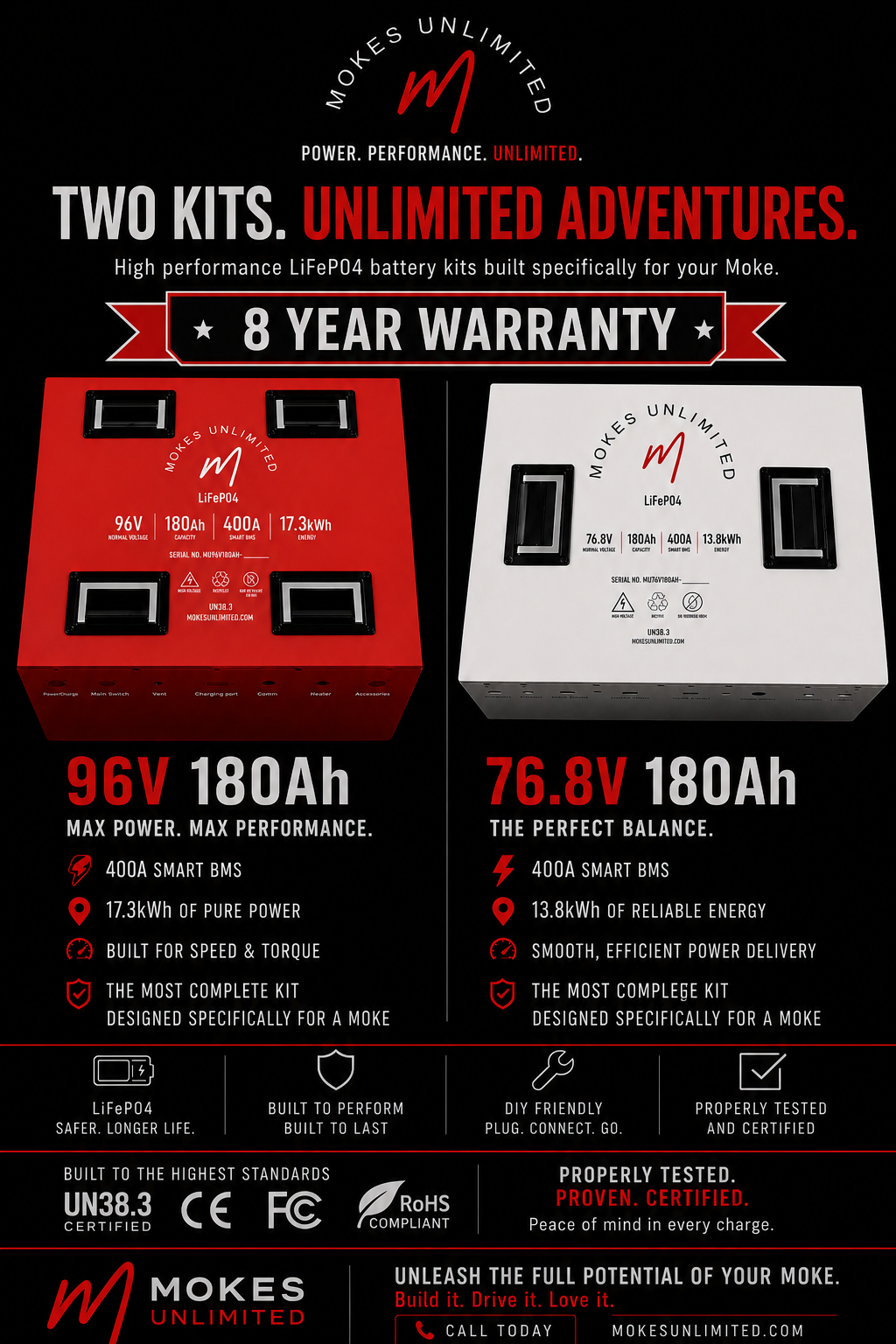
At Mokes Unlimited, we specialize in Moke lithium battery and performance upgrades. Our experience building and testing Mokes has led us to focus on two high-capacity systems: our 76.8V 180Ah Performance Pro and 96V 180Ah performance system.
Here's what Moke owners should understand before choosing a lithium battery.
Why Battery Voltage Matters in an Electric Moke
Voltage is only one part of a lithium system, but it has a major effect on how efficiently power can be delivered to the motor.
A higher-voltage system can deliver the same amount of power at lower current. When combined with the proper motor, controller, wiring, BMS, and programming, higher voltage can provide more efficient delivery of power and significantly greater performance potential. That's why comparing Moke batteries based only on amp-hours can be misleading. You need to consider the entire system.
60V Moke Lithium Batteries
60V lithium systems can be an appropriate replacement for Mokes originally designed around lower-voltage electrical systems.
Their biggest advantage is simplicity. For an owner primarily interested in replacing aging batteries and maintaining relatively stock performance, a properly designed 60V lithium system may be sufficient. However, owners looking for significantly increased capacity, torque, performance, or future motor and controller upgrades may want to consider higher-voltage alternatives.
72V Moke Lithium Batteries
72V-class lithium systems are another common option in the Moke and low-speed electric vehicle market.
They can provide a noticeable improvement over traditional lead-acid batteries, particularly by reducing battery weight and maintaining more consistent voltage throughout the discharge cycle. But voltage alone doesn't determine how capable the system is.
When comparing "72V" batteries, look closely at actual volage (is it only 70.4V), usable capacity (is it only 105aH), BMS current capability (Is it only 200A), physical dimensions, installation requirements, charger compatibility, and the amount of modification required to fit the battery into a Moke.
76.8V 180Ah — A Balance of Range, Performance and Easy Installation
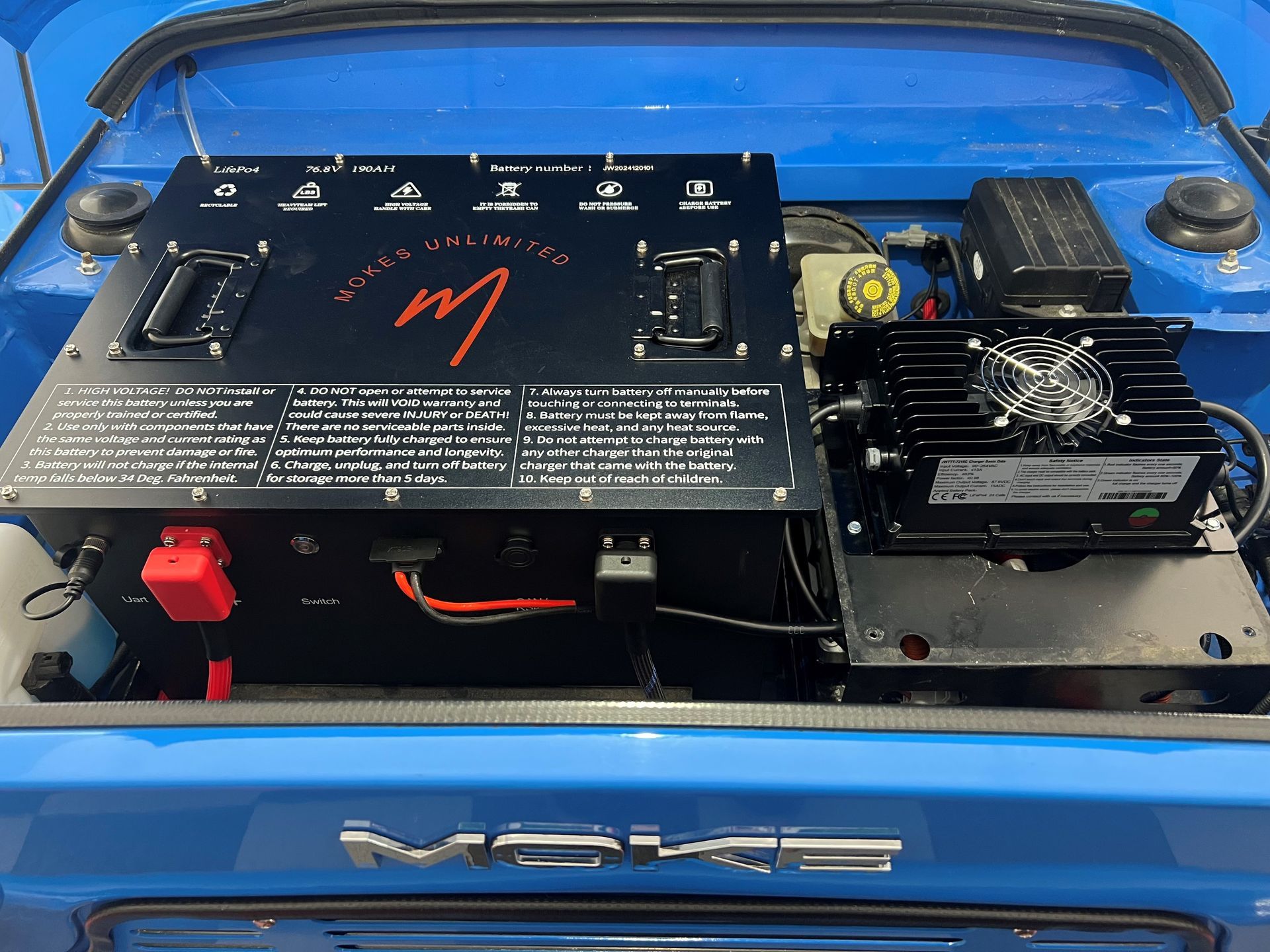
The Mokes Unlimited 76.8V 180Ah Performance Pro LiFePO4 system was designed specifically around the Moke. One of its biggest advantages is something specifications don't always show: its compact physical size. Compact Design. Drop-In. DIY Friendly. Plug & Play.
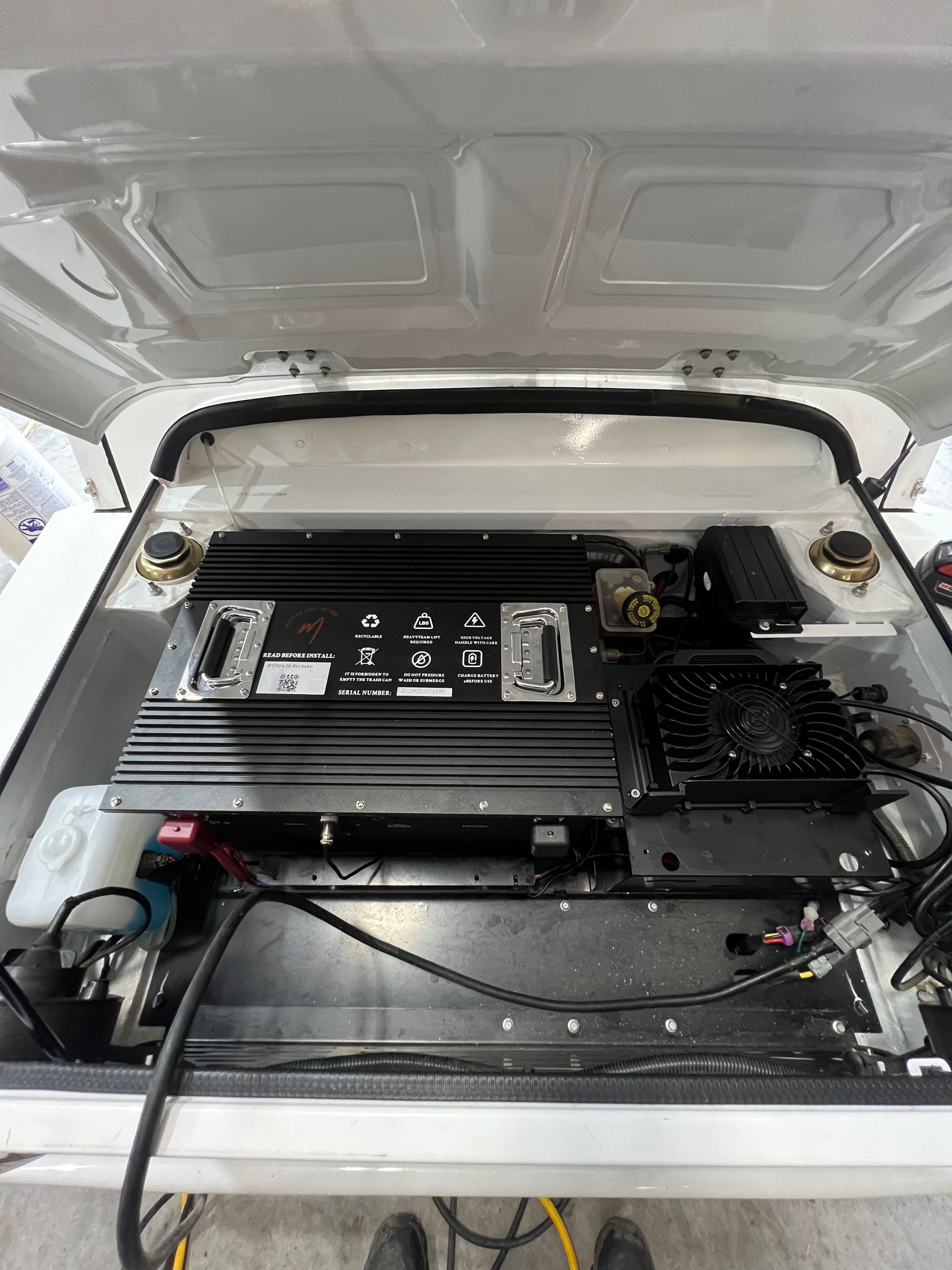
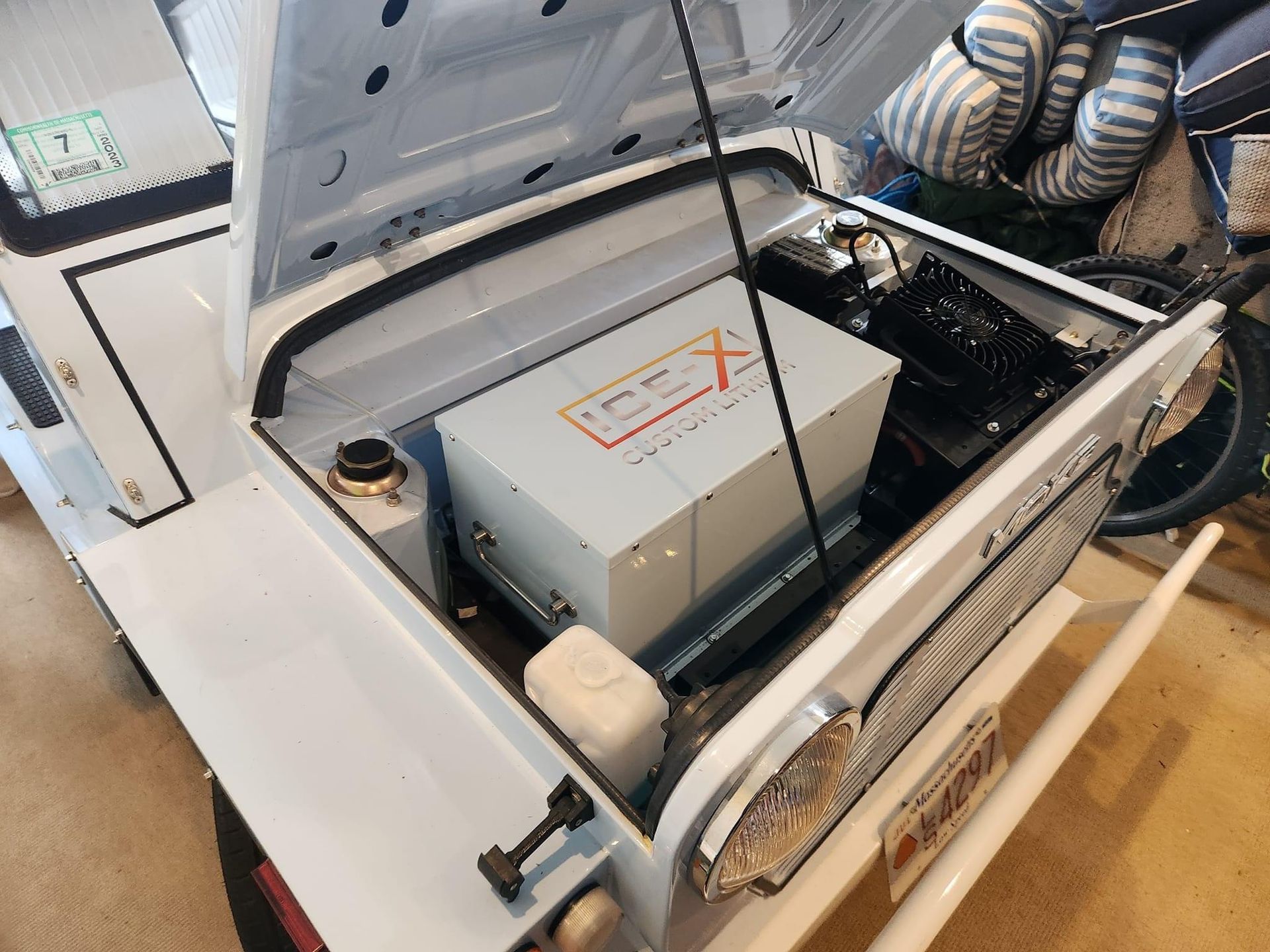
Our compact 76.8V 180Ah lithium battery drops directly into the Moke's existing factory battery tray. No cutting. No fabrication. No special mounting brackets. No vehicle modifications. This makes the 76.8V system particularly attractive to Moke owners looking for a high-capacity lithium upgrade that can still be installed without extensive fabrication. The complete system is designed around the vehicle rather than requiring the vehicle to be extensively modified around an oversized universal battery. For many Moke owners, the 76.8V system represents the sweet spot between capacity, performance, simplicity and ease of installation.
96V 180Ah — Maximum Moke Performance Potential
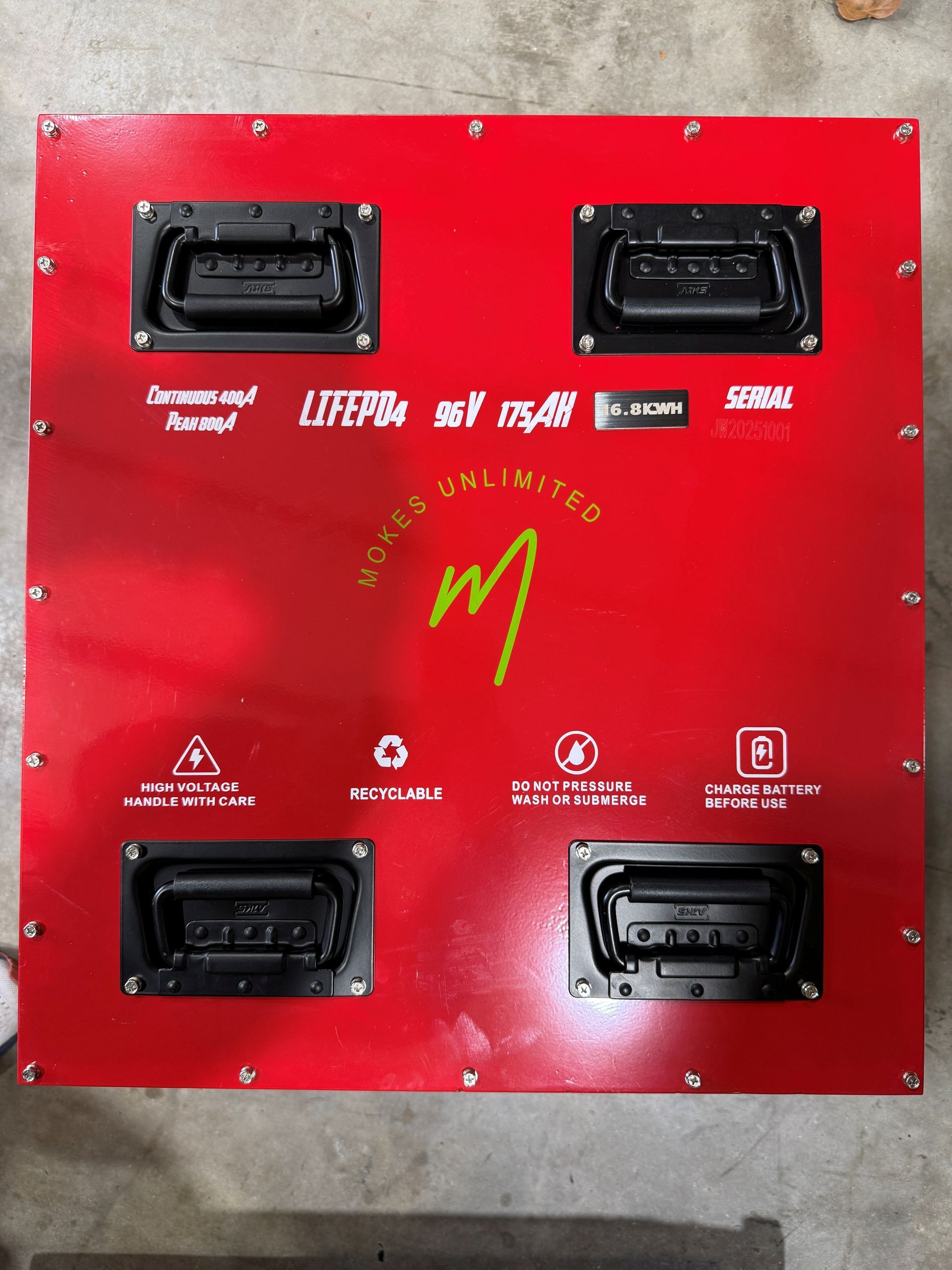
For owners looking for substantially greater performance capability, Mokes Unlimited also offers our 96V 180Ah LiFePO4 system.
At approximately 17.2 kWh of energy capacity, this is an exceptionally large energy reserve for an electric Moke. But capacity isn't the only advantage. Compact Design. DIY Friendly. Plug & Play. The 96V system was designed specifically around the Moke's existing battery location. Despite its substantial capacity, the battery maintains a compact form factor and installs in the factory battery area with only minimal modification. No extensive fabrication or elaborate mounting system is required. When paired with the appropriate high-performance controller and motor, the 96V system provides the foundation for dramatically greater Moke performance while retaining the range and energy capacity expected from a 180Ah battery.
Why Physical Battery Size Matters
This is one of the most overlooked factors when comparing Moke lithium batteries.
Two batteries may have similar voltage or advertised capacity while being dramatically different in physical size.
An oversized battery may require:
- Cutting or modifying the vehicle
- Custom fabrication
- Special mounting brackets
- Relocating components
- Additional wiring
- More installation labor
That's why Mokes Unlimited designs its lithium systems specifically around the physical constraints of the Moke. A battery shouldn't simply have impressive specifications. It should fit the vehicle properly.
Don't Compare Moke Batteries by Amp-Hours Alone
A 180Ah battery isn't automatically better than another battery simply because the Ah number is larger.
A proper comparison should consider:
- Voltage: Influences power-delivery potential
- Amp-hours: Measures electrical charge
- Capacity kWh: Better indication of total stored energy
- BMS capability: Determines how much current the battery can safely deliver
- Cell quality: Influences longevity, consistency and reliability
- Physical size: Determines how easily the battery fits the Moke
- Installation: Drop-in installation can eliminate fabrication and modifications
- Charger: Must be properly matched to battery voltage and chemistry
- Controller: Determines how effectively available battery power can be used
- Motor: Must be appropriate for the desired voltage and performance
- Programming: Critical when optimizing a complete performance system
This is why Mokes Unlimited approaches lithium conversions as a complete Moke system, not simply a battery replacement.
What About the Motor and Controller?
Installing a larger battery doesn't automatically create a high-performance Moke.
The battery, BMS, motor, controller, gearing, wiring, and programming must work together.
Mokes Unlimited offers performance packages incorporating upgraded controllers and 10kW high-torque motors for owners who want to take advantage of the additional capability available from 76.8V and 96V systems. This system-level approach allows the battery, motor, and controller to be selected and configured around how the Moke will actually be used.
Which Moke Lithium Battery Should You Choose?
For owners who want an exceptionally simple installation, substantial capacity, long-range capability, and improved performance while retaining the factory battery location, the 76.8V 180Ah system is an excellent choice.
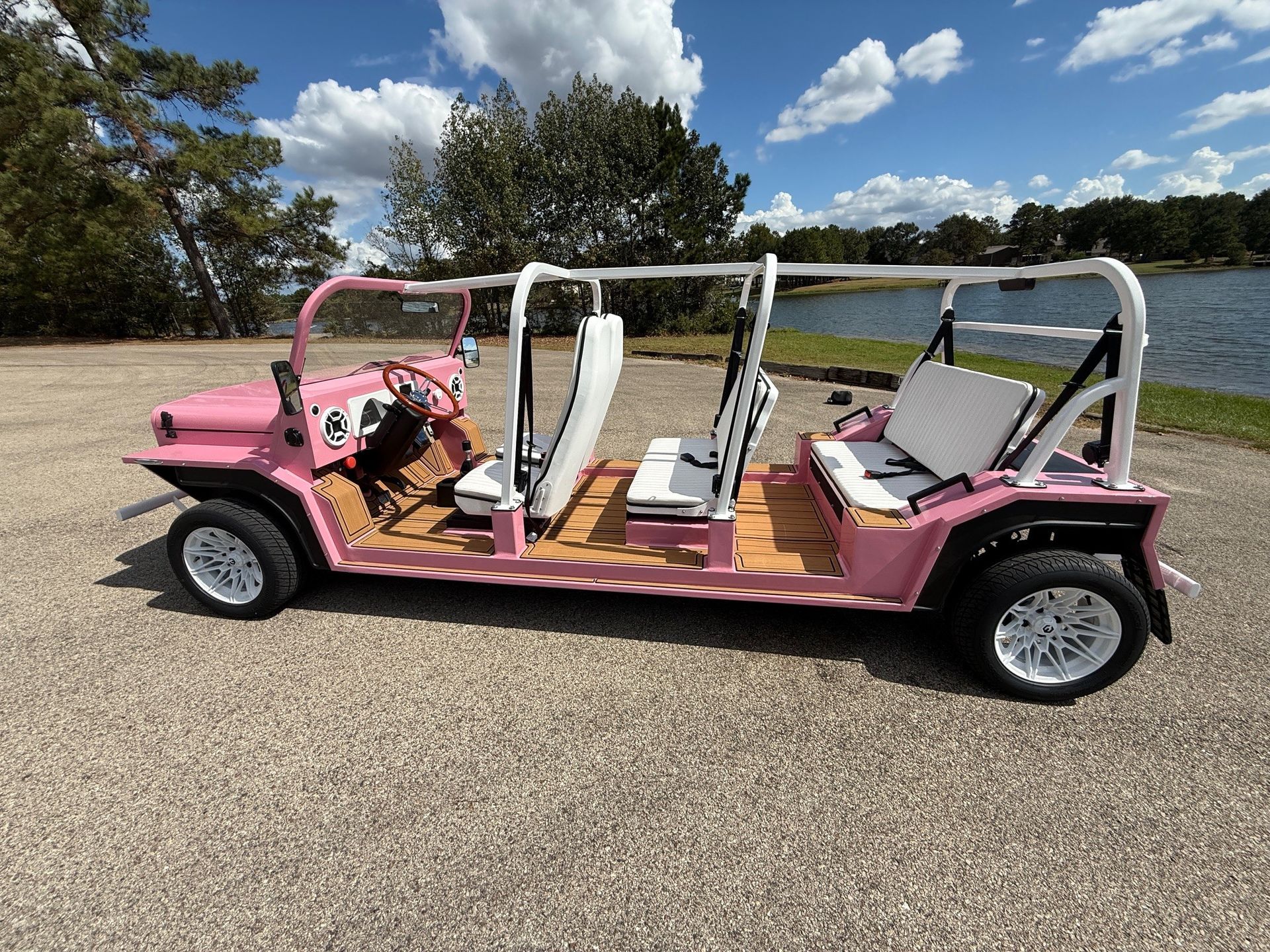
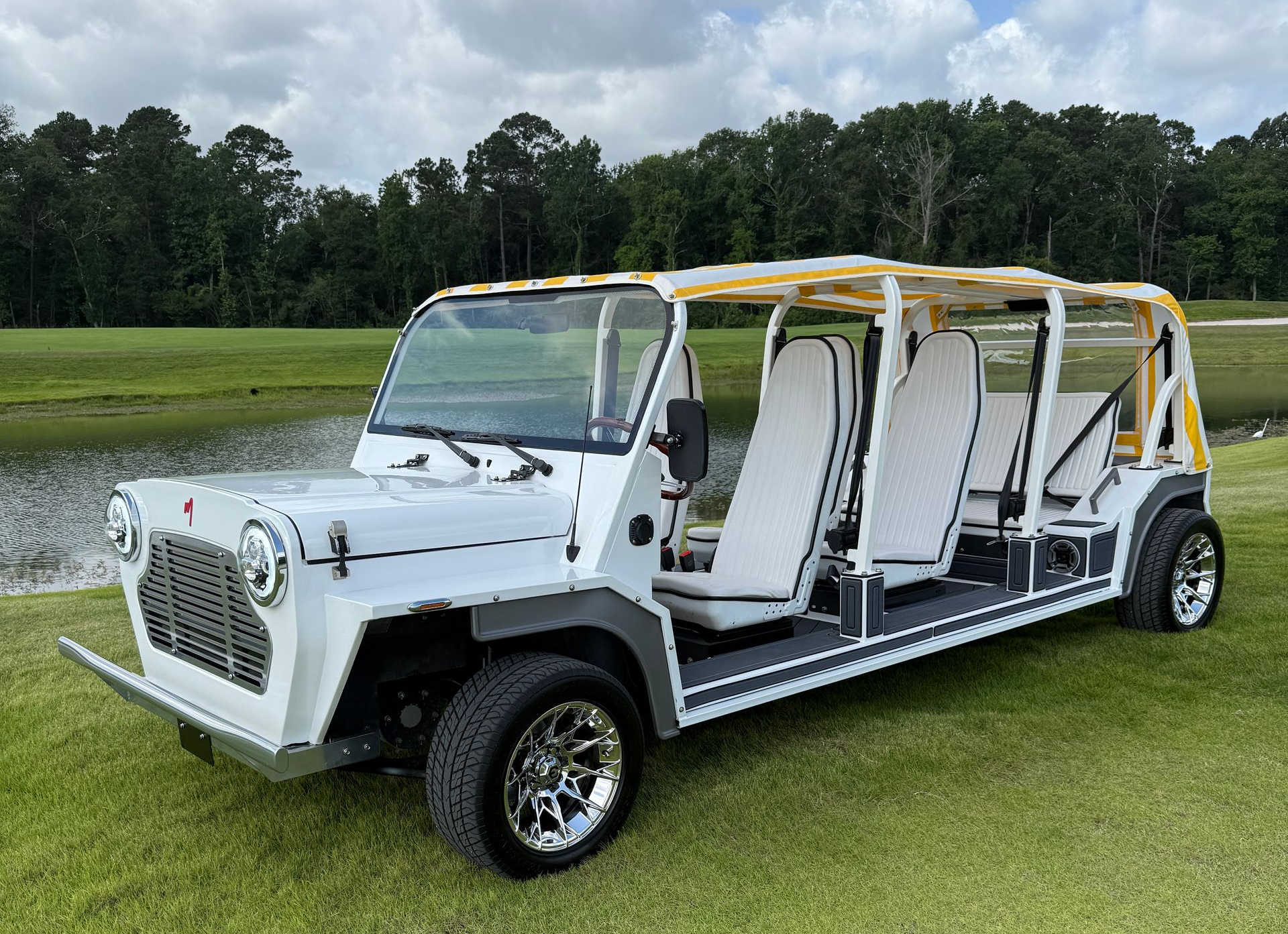
For owners building a higher-performance Moke and looking for maximum energy capacity and substantially greater performance potential, the 96V 180Ah system provides a powerful foundation. The right choice ultimately depends on how you use your Moke. A beach cruiser, neighborhood Moke, long-range vehicle, six-passenger Moke, and high-performance custom build don't necessarily need the same battery system.
The Mokes Unlimited Approach
Mokes Unlimited doesn't simply adapt generic lithium batteries to fit a Moke.
We develop complete Moke-specific lithium and performance systems with an emphasis on capacity, compact packaging, installation simplicity, current capability, and integration with upgraded motors and controllers.
Our current systems include:
76.8V 180Ah Performance Pro — Compact, true drop-in design requiring no vehicle modifications.
96V 180Ah Performance System — Approximately 17.2 kWh of capacity in a compact Moke-specific package requiring only minimal modification.
Both systems are designed to provide Moke owners with a complete upgrade path—from lithium conversion to substantially higher-performance builds.
Learn More
Explore our Moke Lithium Batteries & Performance Upgrades to compare our 76.8V and 96V systems, motor upgrades, controllers, and other performance options.
Mokes Unlimited — Leaders in Moke Performance and Customization.